
Are We Facing the End of Tourism?

Updated: Feb 22

People who work in the tourism industry are typically a very optimistic bunch. Why wouldn’t we be? Our profession offers people who want to travel great experiences, enjoyment, connection with themselves and others, and lasting memories.
While challenged in recent years, industry leaders, especially the public-facing workforce, keep smiling and working to please visitors, keeping travel and tourism moving forward in positive directions.
However, a cold wind has blown over the U.S. travel industry, bringing chilling messages of a trend we’re unused to – that is, a persistent downturn in visitation, notably among inbound international travelers.
The reasons for this trend are many and wide-ranging, but ultimately have converged to result in fewer international visitors and lower spending here over the past few years, with far-reaching impacts.
Unlike natural disasters like fires, floods, or even a pandemic, which we have recently lived through, this dilemma is mainly “man-made.” As such, it is both changeable and resolvable – IF the parties are willing.
To start, the statistical big picture:
In the United States, a total of 72.4 million international visitors arrived in 2024.
68.3 million international visitor arrivals are expected in 2025, a decrease of 5.7% according to Tourism Economics, a noted industry economics consultancy.
They forecast a 3.9% increase in arrivals; however, of this total, 2.6% will come from “regular” visitation, with 1.1% from the World Cup games held in the U.S.
The issue is that U.S. inbound international volume has plateaued or even declined, while countries around the world are experiencing healthy volume growth. In 2024, the U.S. reached only 84% of its pre-COVID inbound visitor volume and continues to lose share of this critical segment.
“The U.S. is losing share again in 2025,” said Adam Sacks, CEO of Tourism Economics. “We don’t expect it to recover that share within our forecast horizon.” This shows “how dire this has been for the U.S. compared to competing destinations.”
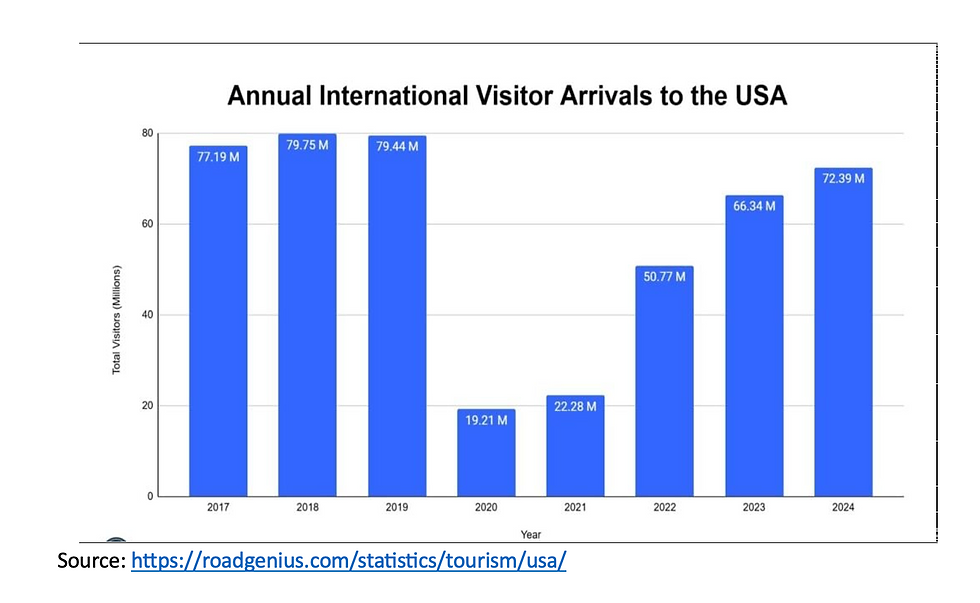
Of overseas arrivals from the U.S.’ top 20 markets in 2025 versus 2024, 11 increased, while the other 9 decreased, yet the overall net effect was a -5.7% decline in volume.

Are we as a country predestined to continue down this path? What factors are driving this dynamic? What, if anything, can the U.S. do about it, both within and outside of the tourism industry?
These factors have been cited in a thoughtful – and thought-provoking – article by Karen Kerrigan, President & CEO of the Small Business & Entrepreneurship Council, and which I have elaborated below.
Driving the Decline
Processing Costs

Issue: Costs deter travel into the U.S. due to factors both beyond and within our control. Two aspects of cost are process fees to enter the U.S. and affordability, i.e., our comparably higher costs (in real dollars and relative to the still strong $US). Visitors pay for lodging, meals out, transportation, and other items purchased on their trips.
According to Kerrigan, the complexity and cost of navigating the U.S. visa process, along with associated fees and other travel costs, pose real hurdles for travelers. How many are willing – or now unwilling - to brave the process effort and costs simply to qualify to come here?
Solutions: For the U.S. to effectively compete for international travelers, policies and practices must include lowering costs. The U.S. government recently increased existing visa fees and imposed new ones for visa waiver and other countries. These are per traveler and add up to processing costs that exceed those of any other country, merely for applying to visit here! Kerrigan proposes scrapping the new $250 Visa Integrity Fee, which would raise the cost of a U.S. tourist visa from $185 to approximately $435, making it the highest in the world.
Travel Affordability
Issue: Travel Cost: This issue is not easily resolved in our inflationary, strong U.S. dollar economic environment. It is driven by both higher business costs (passed on to consumers) and lower revenues from reduced visitation and spending. Affordability also skews the market mix; higher-income people are more able to travel, leaving those less well-off traveling less.
Potential Solution: DMOs are well-positioned to work with their stakeholder businesses (and with one another) to develop special discounts and value-added programs that help visitors feel their travel budget is well spent. This is especially true for lodging, often the highest travel cost category; travelers have been smart in mitigating this expense by downshifting to lower-cost lodging, using their loyalty points, and/or booking alternative non-hotel lodging, which has impacted hotel industry performance (and, to some extent, perceptions).
Ease of Entry, Welcoming
Issue: Beyond cost are the length and complexity of the process itself, denigrating comments by government officials targeting certain countries, and visible violent immigration actions, making our international friends feel unwelcome and potentially unsafe to be here, even as visitors.
Solutions: As Kerrigan noted, the upcoming major international events and America’s attractiveness as a destination can potentially attract millions of overseas visitors and generate substantial economic activity. However, to remain attractive and competitive, the U.S. needs messaging and actions to ensure that inbound global travelers feel welcomed and are not deterred when planning their trips.
In Kerrigan’s 2023 Travel Pulse op-ed, “Fixing the U.S. Visa System is an Urgent Priority”, she attributed many of these visitation and spending challenges to a clunky, bureaucratic system….she urged the Administration to push forward policies and processes that will support the expected influx, such as to address FIFA World Cup 2026, the Administration has since implemented the FIFA Priority Appointment Scheduling System, or “FIFA Pass” program to provide ticket holders with expedited visa interview appointments, complemented by the hiring hundreds of new officers to augment consular staffing throughout the world to shorten visa wait times.

● Reduce the wait time for Visas. The wait time for a simple interview can take months in high-demand countries. The FIFA Pass model – specifically, shortening wait times – should extend to inbound travel in general.
● Reconsider surveillance overreach and red tape on low-risk, high-spend travelers. A new study released by WTTC finds that the drop in international visitors due to the new rules (one-third of travelers surveyed said they would be “somewhat or much less likely to visit the US if applicants to the Visa Waiver Program are required to submit information about their social media accounts”) could cost the US. an estimated $15.7 billion in lost visitor spending. According to a CNN report, “Under one scenario, the U.S. could miss out on as many as 4.7 million international arrivals, which would represent a 23% drop in visitors from ESTA countries in 2026.”
● Improve seamless and secure travel: Progress is being made in deploying technology to make the travel experience more seamless and secure, but more work is needed. The Administration and agencies should continue to pursue and implement the smart changes and fixes outlined by the U.S. Travel Association’s Commission on Seamless and Secure Travel.
U.S. Perceptions and Marketing
Restoring Brand USA’s Funding
Issue: Costing zero taxpayer dollars, restoring Brand USA funds transfers surplus Travel Promotion Fund dollars (from ESTA fees) back to Brand USA. A devastating reduction in July 2025, via the "Big Beautiful Bill," slashed Brand USA’s federal match by 80%, from $100 million to $20 million.
It is critically important that Brand USA is sufficiently and reliably funded for many reasons: having much more control, continuity, and alignment over international marketing on behalf of the country as a whole; by marketing and communicating positive, welcoming, reassuring messaging to the world, and reestablishing the U.S.’s position as an attractive, safe, and welcoming destination.
Solution: The U.S. Travel Association, which is highly engaged on this issue, reported that after the government shutdown in November 2025, Congress passed legislation that, for the time being, restored Brand USA's federal matching fund. Now under consideration is the VISIT USA Act, a bipartisan bill to ensure funding for fiscal years 2026 and 2027, by transferring $160 million in surplus fees from the Electronic System for Travel Authorization (ESTA) to Brand USA to support its marketing efforts ahead of the 2026 FIFA World Cup and 2028 Olympics.
As of early 2026, the legislation has been referred to the House Committee on Energy and Commerce and the Senate Commerce, Science, and Transportation Committee, and has yet to be brought to a full floor vote in either chamber.
Going Forward – Optimism and Challenges

As noted, Tourism Economics and Industry leaders, ever optimistic, are projecting 2026 as a "rebound year" for international visitation, largely driven by our hosting of the FIFA World Cup this summer.
However, real structural issues still lay beneath the surface, including, as discussed above, our high entry processing fees, processing time, affordability of travel costs once here, damaging comments targeting specific countries and their residents, negative perceptions of the U.S. among potential visitors from such comments, and from media images of immigration raids, and the lack of reliable, stable, and sufficient long-term funding for Visit USA.
Is U.S. International Tourism Dead?
My verdict - I think not! However, the patient needs much attention and TLC to restore it to its former position as the world’s most attractive and aspirational destination.
In our favor, the tourism industry is highly collaborative and mutually supporting; we understand that the benefits of international inbound visitation accrue across geographic regions and industry sectors, to the advantage of the overall industry.
Our job – and challenge – is to engage further others who are impacting this situation, so we are in synch with what needs to be done to assure our world position.
Research should be conducted in real time to track international visitors' perceptions and intent to visit.
Communication must be in place to restore and maintain the industry at the level it should be, so the many benefits can be realized for all concerned, in the short and long term.
So, the reveal: I, too, am a tourism optimist, but one who believes we must act and stay active!


Comments